


OVERVIEW
Engineered for 2-Stroke Engine Applications!
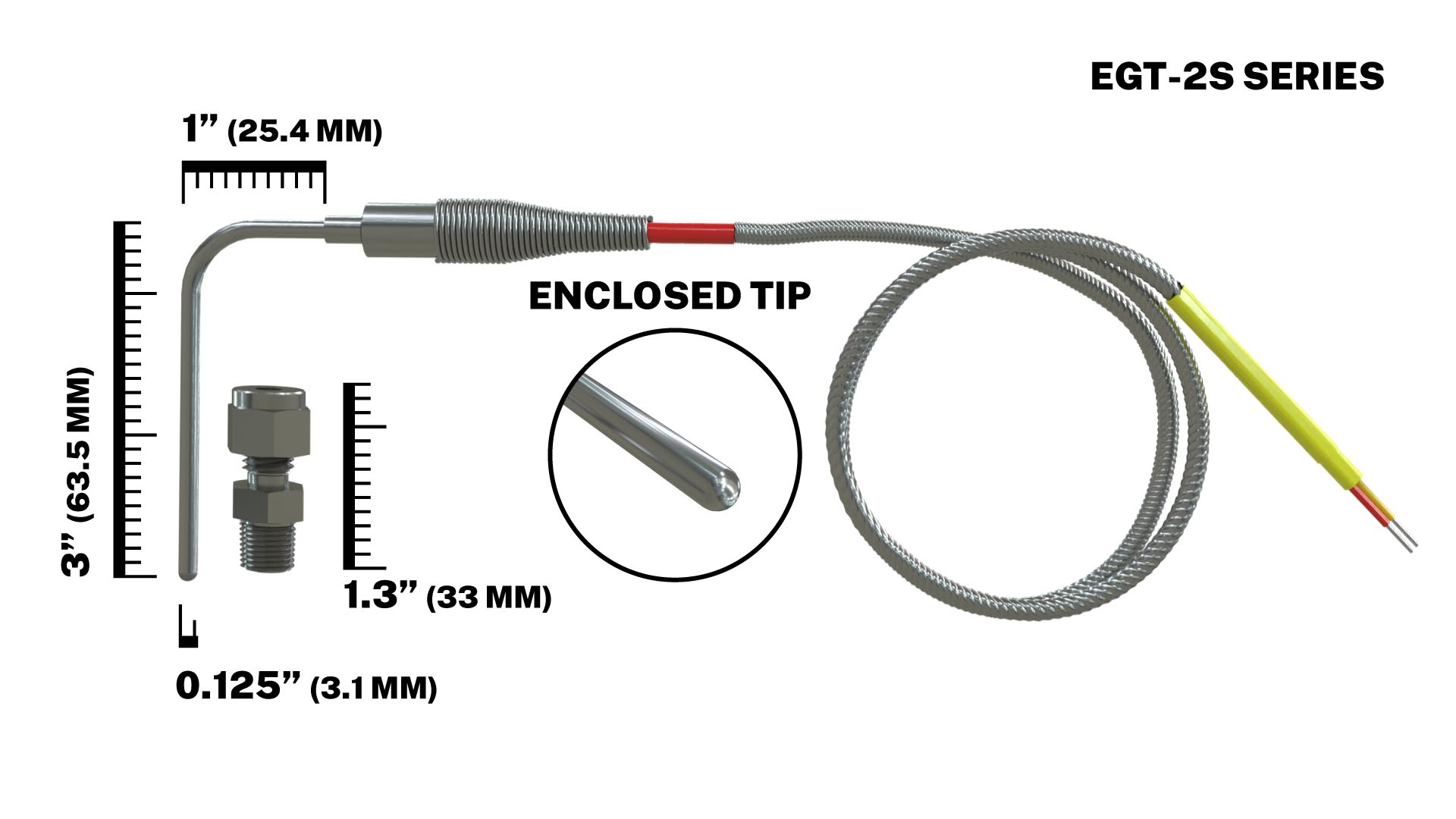
• Probe diameter 1/8 inch (0.125 inch)
• Enclosed Tip Sensing Junction (Foul Proof)
• Response time constant: 550 milliseconds
• Includes 316 SS adjustable compression fitting
(Recommended for fuel types: Gasoline / Oil mixture)
MADE IN THE USA
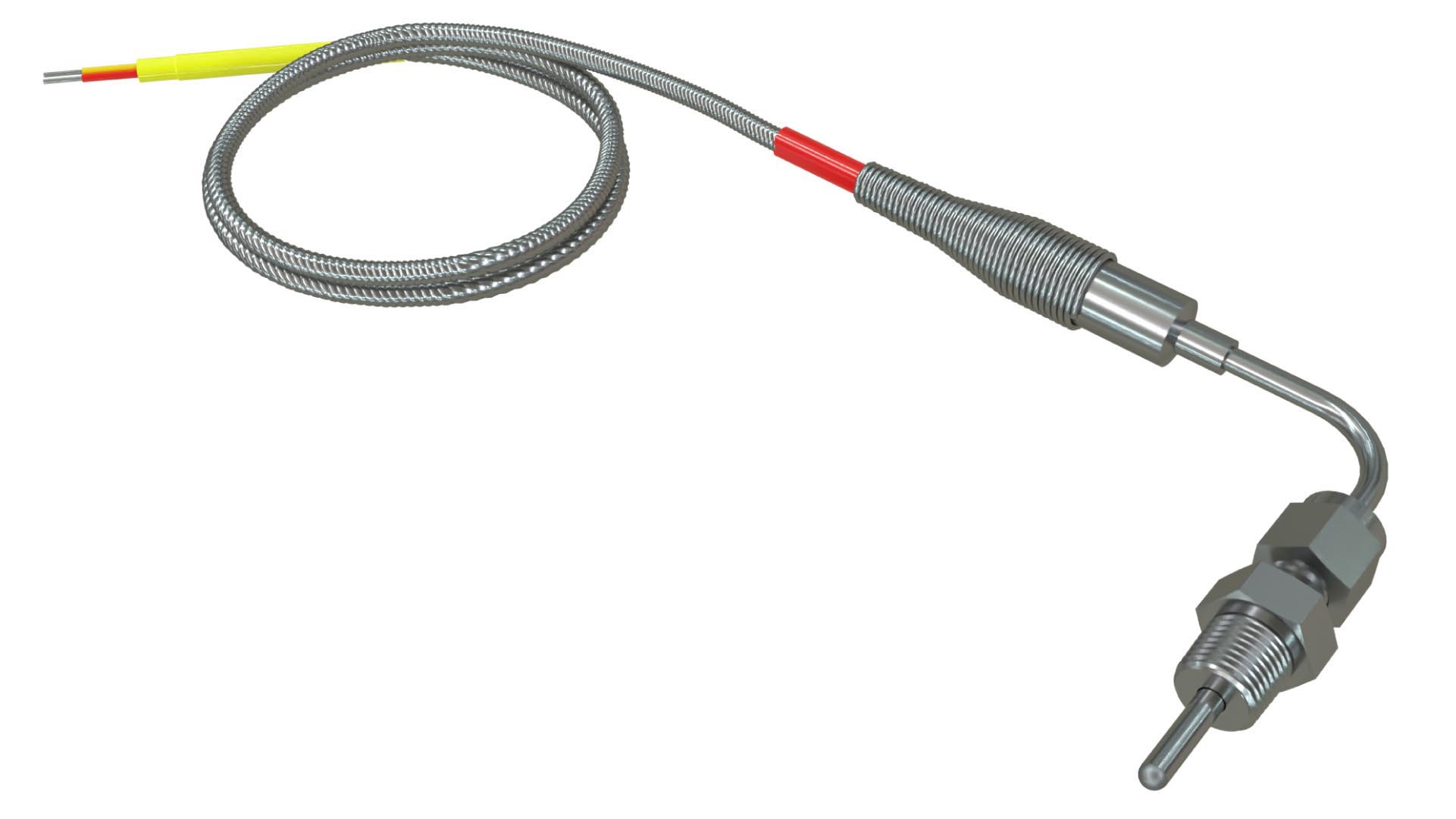
The Exhaust Gas Temperature Sensor is specifically designed for use in 2-Stroke Engine applications. Made in the USA from superior materials. The Enclosed Tip sensing junction provides reliable measurement of temperature changes.
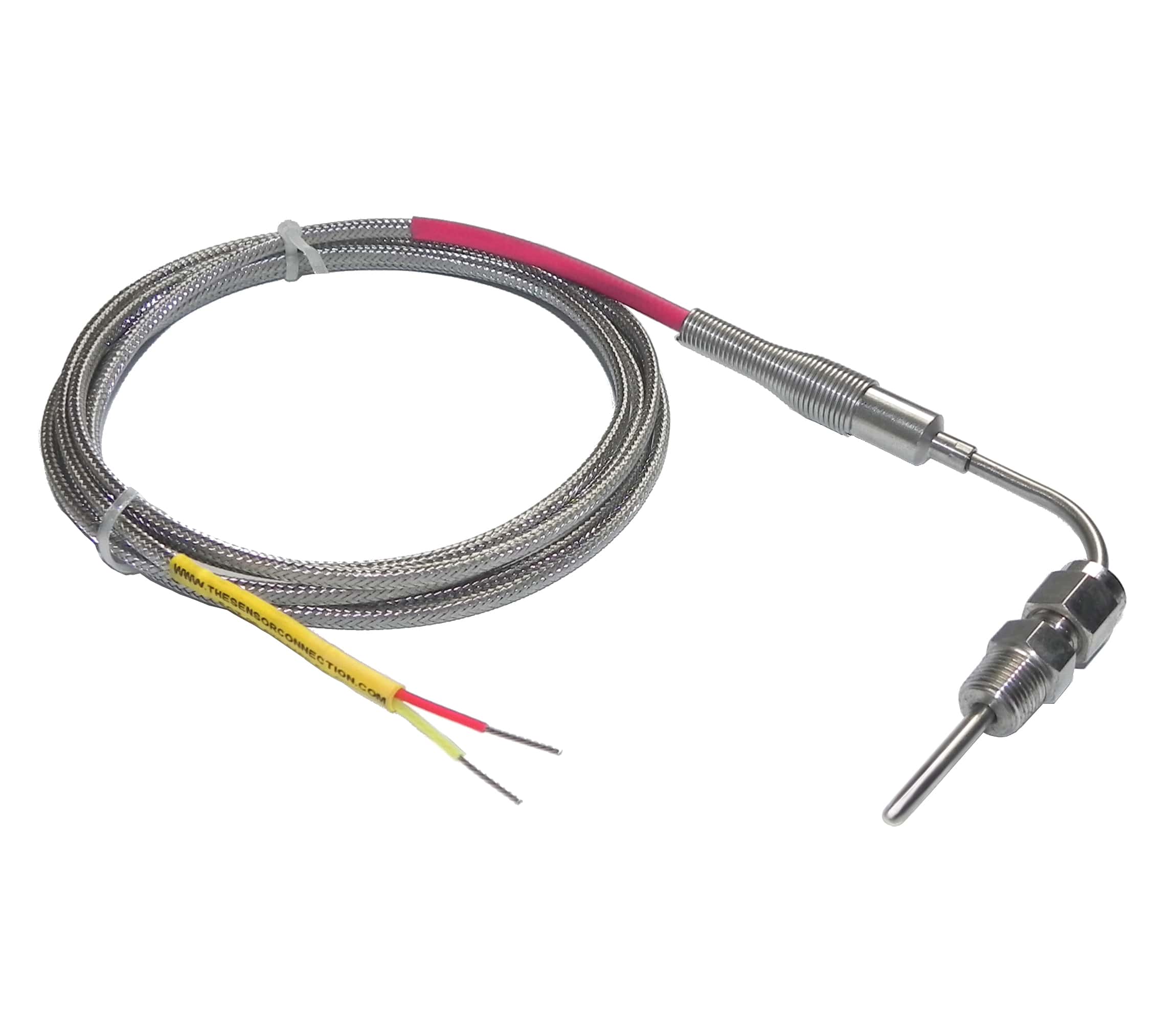
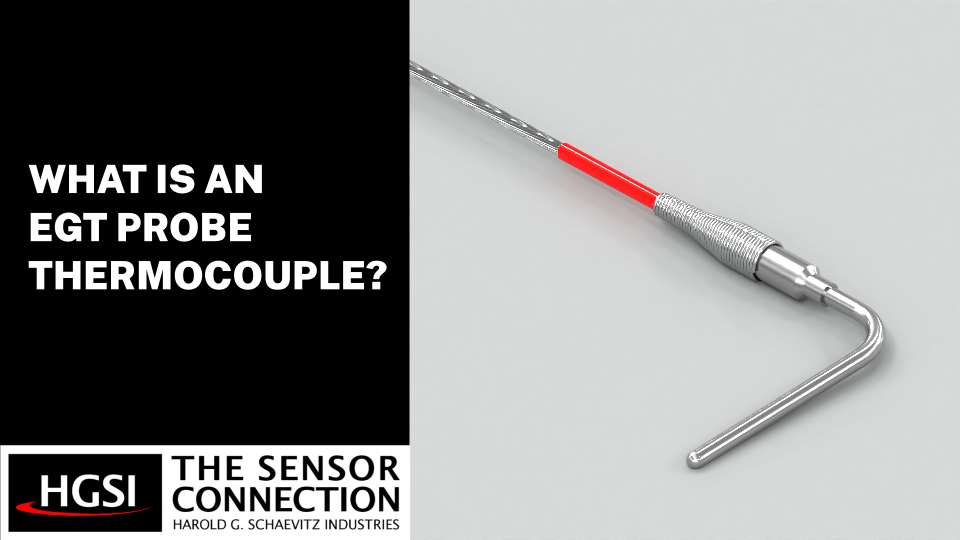
The Exhaust Gas Temperature Probe is capable of surviving extreme vibration and heat up to 2300 degrees F (1300 degrees C). The EGT probe is 0.125" diameter (3.175 mm) with a 90-degree bend to accommodate tight mounting locations. An adjustable (316 Stainless Steel) 1/8" NPT compression fitting adapter is included. The EGT probe cable lead length is 6 feet (1.8 meters) or 12 feet (3.6 meters).
IMPORTANT NOTE: 1/8" probes are not recommended for applications with high Exhaust Gas velocity or mounting pre-turbo (choose a 3/16" OD or 1/4" OD probe). Please confirm with your instrument manufacturer that the instrument is compatible with a Type K thermocouple sensor.
Options:
TECHNICAL SPECIFICATIONS
Thermocouple type: | Type K |
Temperature Range: | -148°F to 2372°F range (-100°C to 1300°C) |
Accuracy: | +/-0.4% of reading or about +/- 1.1°C (Special Limits of Error) |
Probe Diameter: | 1/8 inch (0.125 inch) (3.175 mm) |
Max Tip Insertion Depth: | 0.85 inch |
Response Time: | 550 mS |
Outer Sheath Material: | Inconel, melting point 2550°F (1400°C) |
Sheath Wall Thickness: | 0.015" (.38 mm), MgO insulated |
Cable: | Stainless steel over-braid cable with FEP insulated conductors; 6 foot |
Included Compression Fitting: | 316 stainless steel, adjustable, 1/8 inch –27 NPT male thread |
DOCUMENTS & DOWNLOADS
VIDEOS

RELATED PRODUCTS
APPLICATIONS AND TECHNICAL DETAILS
Why 2-Stroke Engines Require a Dedicated EGT Probe Series
The exhaust environment of a 2-stroke engine is fundamentally different from a 4-stroke in ways that directly affect probe design requirements. First, 2-stroke exhaust temperatures are higher relative to displacement — the absence of a separate exhaust stroke means combustion gases are expelled while the next charge is already entering, running the exhaust system hotter than a comparable 4-stroke.
Second, 2-stroke engines burning gasoline-oil premix produce exhaust byproducts that include partially burned oil vapor and carbon compounds that can foul a thermocouple junction over time, particularly at idle and part-throttle operation. Third, 2-stroke pipes are typically small-diameter expansion chambers where probe placement options are constrained.
Enclosed Tip: The Right Call for 2-Stroke Chemistry
The EGT-2S uses an enclosed, ungrounded Type K thermocouple junction, meaning the sensing wires are fully protected within the Inconel sheath rather than exposed to direct exhaust gas contact.
This design is specifically intended for 2-stroke exhaust chemistry. An exposed-tip probe in this environment will accumulate carbon and oil deposits over time, eventually forming an insulating layer that causes the probe to read artificially low before failing.
The enclosed tip prevents direct contamination, extending sensor life and maintaining measurement consistency. The tradeoff is a 550 millisecond response time (time constant), which is appropriate for 2-stroke EGT monitoring where reliability is more critical than capturing extremely fast transient events.
Response time is defined as the time required to reach 63.2% of a step temperature change.
EGT as a Critical Safety Metric in 2-Stroke Operation
In 2-stroke engines, EGT monitoring is not just for tuning — it is a primary engine protection tool. These engines operate with narrow thermal margins, and overheating can lead to piston seizure within seconds.
EGT provides a real-time indication of combustion temperature. Elevated readings can indicate lean mixture, insufficient cooling, or excessive ignition advance, while low readings may indicate an overly rich condition or poor combustion efficiency.
Because of this, measurement stability and long-term reliability are more important than absolute response speed, making the enclosed junction design the correct choice.
Compact Diameter for 2-Stroke Pipe Geometry
The EGT-2S uses a 0.090" (2.3 mm) diameter probe, smaller than standard 1/8" designs.
This reduced diameter is critical for 2-stroke applications, where expansion chamber exhaust systems are typically narrow and sensitive to flow disruption. A larger probe would introduce unnecessary backpressure and affect exhaust tuning characteristics.
The 90-degree bend geometry allows the probe body and cable to route cleanly along the pipe exterior in the tight packaging typical of 2-stroke powertrains.
Installation and Snowmobile Applications
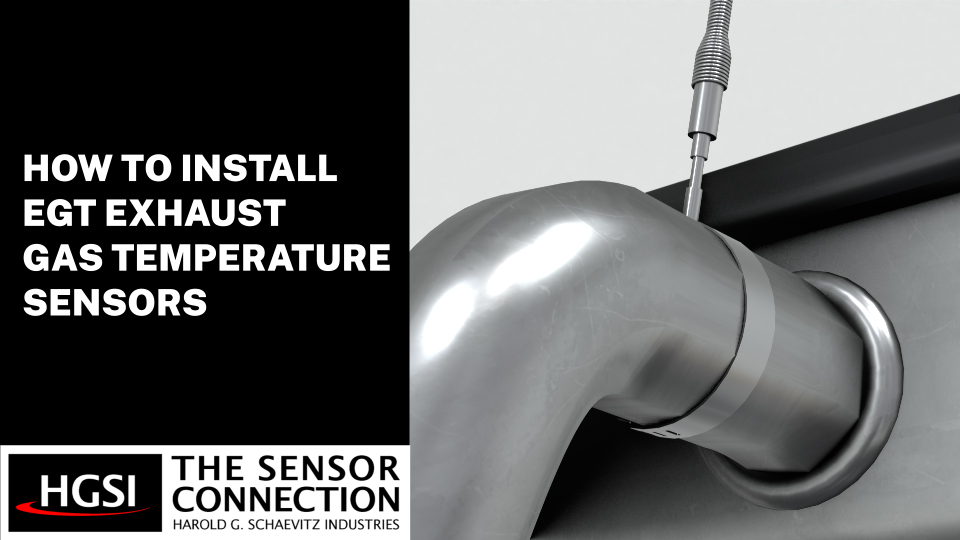
The probe includes a 316 stainless steel adjustable compression fitting with 1/8"-27 NPT male threads, allowing installation in a standard tapped port.
Maximum insertion depth is 0.85 inches, which should be considered when positioning the probe within the exhaust stream.
The EGT-2S is commonly used in snowmobile applications, where ambient temperatures can reach -40°F while exhaust temperatures exceed 1200°F. The stainless steel overbraid and Teflon-insulated cable maintain flexibility and durability across this wide thermal range.
Construction and Specifications
- Thermocouple type: Type K
- Temperature range: -148°F to 2372°F (-100°C to 1300°C)
- Accuracy: ±0.4% of reading or ±1.1°C (Special Limits of Error)
- Probe diameter: 0.090" (2.3 mm)
- Junction: Enclosed, ungrounded
- Response time: 550 ms (time constant)
- Sheath material: Inconel
- Cable: 20 AWG stranded, Teflon insulated, stainless steel overbraid
Type K polarity must be maintained:
- Yellow = Positive (+)
- Red = Negative (–)